It starts as a subtle twitch in your camera angle. Then, your character starts walking to the left on their own. Stick drift is the nightmare of every gamer. But to fix it permanently, we must first understand the physics occurring inside the plastic shell.
1. Anatomy of an Analog Stick
Most modern controllers, including the DualSense and DualShock 4, use joystick modules manufactured by ALPS Alpine. These are not digital switches; they are analog components based on a technology called the Potentiometer.
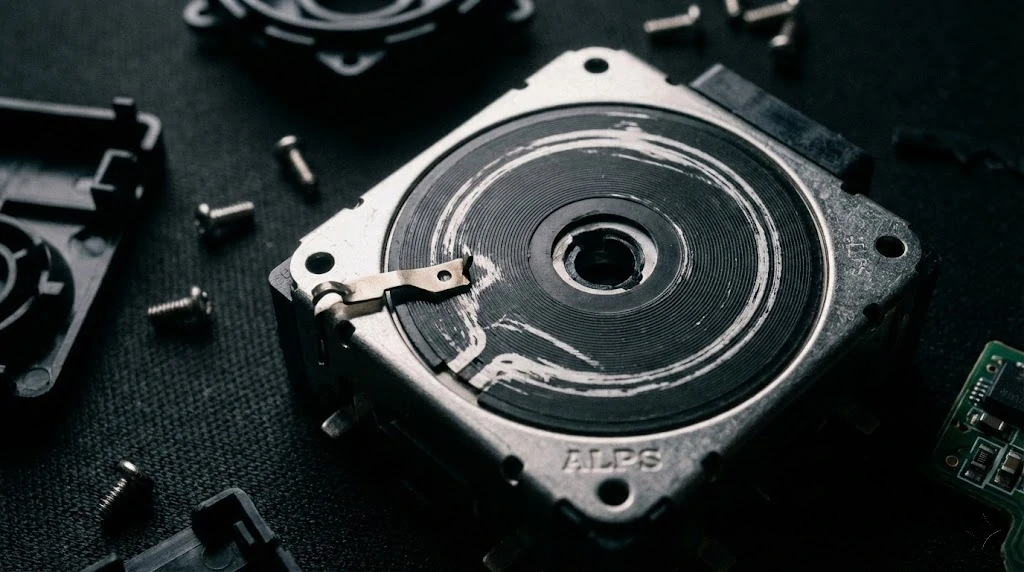
The mechanism relies on two key parts:
The Resistive Track
A semicircular strip made of Carbon, which acts as a resistor.
The Wiper
A small metal arm that slides physically across the carbon track when you move the stick.
The Voltage Divider Principle
Electrically, the joystick acts as a voltage divider. The console reads the voltage output ($V_{out}$) which changes based on the wiper's position on the resistive track.
$$V_{out} = V_{in} \times \frac{R_2}{R_1 + R_2}$$
When the wiper is perfectly centered, the resistance should be balanced. Drift happens when this balance is lost.
2. The Physics of Failure
Friction is the enemy. Every time you move the stick, the metal wiper scrapes against the carbon track. Over hundreds of hours of gameplay, two things happen:
- Wear: The carbon layer physically thins out, changing its electrical resistance.
- Debris: Microscopic carbon dust accumulates, creating "phantom" conductive paths.
This causes the sensor to report a voltage value (e.g., 2.6V) even when the stick is physically centered (which should be 2.5V). The console interprets this extra voltage as "Movement".
3. Why "Deadzone" is NOT a Fix
Most games and tutorials suggest increasing the Deadzone. This is a software filter that tells the game: "Ignore any input below 10%."
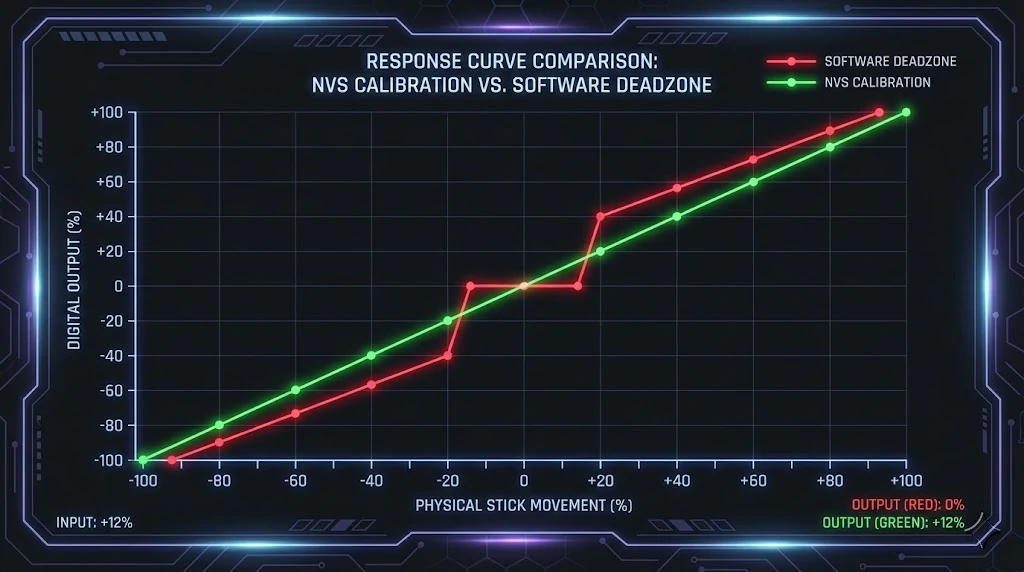
While this stops the camera from moving on its own, it comes at a heavy cost:
- Loss of Precision: You lose the ability to make fine, subtle movements.
- Input Lag Feeling: You have to push the stick further before the character reacts.
4. The NVS Calibration Solution
This is where AB Control Hub differs. Instead of ignoring the error, we fix it at the source.
Modern controllers have an internal memory chip called NVS (Non-Volatile Storage). This chip stores the "Zero Point" calibration data. Our tool calculates the exact error offset caused by the wear in your specific controller and writes a new "Center" value directly to the NVS.
The result? A controller that is perfectly centered at the hardware level, with Zero Deadzone required.